



(c)2012 egyptwithomarsharif.com . All Copy Rights Reserved.
Designed & Hosted by:


Pompey pillar
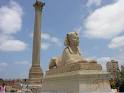
The so called Pompey’s Pillar is the highest column in Egypt. It is a huge column of red granite, its total height is about 28 m with a diameter at the base of 2,7 m. and the towards the capital at the top it tapers to 2,3 m.
On the upper part at the western side is an inscription in Greek which can be read “To the most just Emperor, tutelary of Alexandria Diocletian, the invincible, Postumus, the Prefect of Egypt (has erected this monument).”
The Roman ruler of Egypt during the reign of the Roman Emperor Diocletian erected this memorial column between 284-305 A. D in honour of his Roman Emperor as a sign of gratitude. A serious revolt in the city took place and Diocletian came himself, ordering the city to be besieged, after 8 months of resistance the city finally surrendered. As a result of the siege there was a famine in the city therefore the Emperor ordered that a portion of the corn which was sent to Rome annually, be given to the people of Alexandria. He exempted them from paying taxes during these hard times. For that they erected in his honour this memorial column. In the middle ages the crusaders believed mistakenly that the ashes or the remains of the great Roman general Pompey were put in a pot and placed at the top of the column. Thus today it is called Pompey’s Pillar.
Around the commemorative Column of Diocletian there are some monuments that can be seen. On the backside, there are remains of a Serapium or a temple of god Serapis, now badly damaged.
It was built during the reign of Ptolemy II and Ptolemy III, but it was damaged due to the revolts of the Jewish population in Alexandria during the reign of the Emperor Trajan (89-118 A.D).
It was rebuilt again during the reign of Hadrian (117-137 A.D). Likely was destroyed once more after the appearance of Christianity. It consisted mainly of a high platform accessed by a staircase of 100 steps.
At the side of the platform there was a basin which was used for purification. There were 2 galleries at the back of the temple.
Both galleries were cut completely in the rock. In the 1st gallery a black statue of basalt, dates back to the reign of Hadrian, was discovered, it represents god Serapis in a shape of a bull, now it is exhibited in the Greco-Roman Museum in Alexandria.
The 2nd gallery is known mistakenly as the Daughter Library but it seems that it was Anubidiun or a burial for the mummies of Anubis, which was considered till the a reign of Ptolemy IV a member of the Pantheon of Alexandria.
Alexandria Sight Seeing
Packages
Tours
Travel Tips
Glossary
Egypt Info
History
Sight Seeings
Egypt With Omar Sherif - Your Egypt Travel Expert


Facebook Page

10.jpg)
17.jpg)
17.jpg)
15.jpg)
14.jpg)
www.egyptwithomarsharif.com